

If you are lying in bed at 2am with your eyes wide open and your mind running laps, the quickest way to fall asleep is to give your brain one calm thing to focus on. That is what all three techniques below do. They work for me on most nights, they work for the people who come to my classes, and none of them require any special skill. They do require practice, so be patient with yourself.
One thing to say up front: falling asleep at night depends a lot on how you have prepared during the day. Caffeine, sugar, screens and a body that has not moved all make it harder. If you want to work on that side of things, read 6 ways to improve your sleep quality. This post is for the moment you are already lying there and need help now.
1. Listen to singing bowls to slow your brainwaves
When you cannot sleep, you need to reduce two things: the number of thoughts in your head and the intensity of them. Listening to singing bowls played in a particular way can do both.
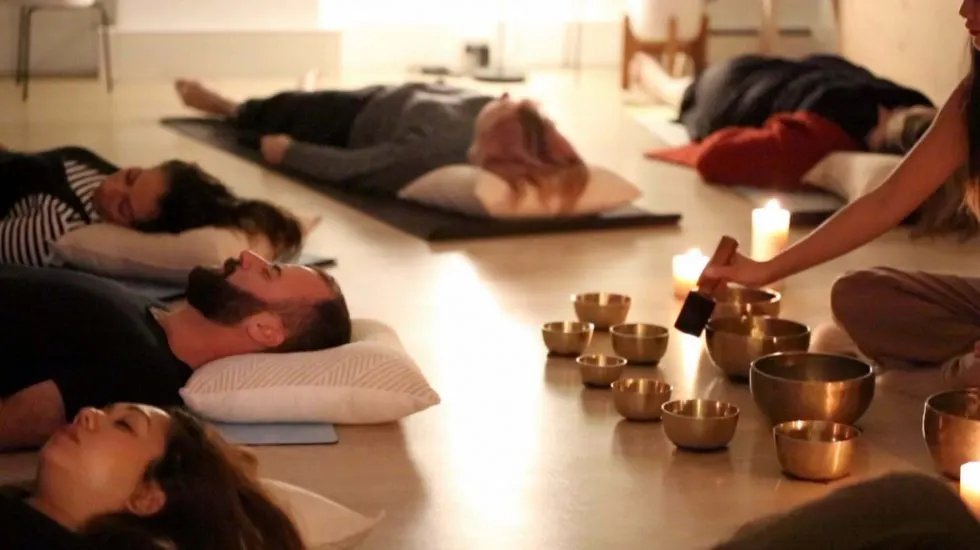
Anyone who has been to a Mirosuna sound meditation knows that crystal and Tibetan singing bowls, played with the right technique, can send half the room to sleep. The frequencies and vibrations help shift your brain from an active, alert state through to a relaxed one and, eventually, a deeply relaxed one. The sounds are also interesting enough that your brain becomes curious and gravitates toward them, so you forget the thoughts that were keeping you up.
A fun fact: when I was editing the recording for my own singing bowl track, I fell asleep several times and could not make it to the end. That track is now in our store as a Tibetan singing bowl sound meditation and was created specifically to help you sleep. Wear headphones, lie down and let it do the work. If you would like to understand why sound has this effect, we have written about the science behind sound healing.
2. Do a meditation that powers you down, not up
Before you skip this one because you think meditation is too hard, let me show you that it is not. This is my go-to technique when I cannot sleep and it works for me about nine times out of ten. The two exceptions are when I have had far too much sugar or caffeine (no amount of meditation will fix that) or when I am wrestling with something big that needs more time to work through.
Most people leave meditation as their last option because they assume it is difficult. Once you get the hang of it, it becomes your first option.
Meditation works because it gives your mind a single point of focus. If I ask you to imagine standing in the sun, the rays warming the hairs on your arm, your toes shuffling in hot sand, you are not thinking about tomorrow's meeting. As you follow a visualisation, your energy settles, your brainwaves slow and you drop into a deeply relaxed state that sits right next to sleep.
You can learn a meditation and guide yourself through it, or listen to a recorded one in bed with headphones. In my in-person classes I teach sleep meditations so you can run them yourself on the nights you need them. If you cannot get to the studio, the simple meditation at the bottom of this post is a good place to start. Slow, deliberate breathing is a big part of it, and if you want more on that, read our guide to breathwork.
3. Write it down
Some nights you are awake because your brain is holding a to-do list and refuses to put it down. On those nights, get back up and do this:
- Put pen to paper and write your to-do list in bullet points. Try not to use your phone, as the light will only wake you further.
- Remind yourself that everything is now written down, so you can rest without the risk of forgetting anything.
- Say this to yourself: I do not need to worry. I have written down everything I need to do and it will be there when I wake up. I cannot fix something at 2am that is outside my control right now.
- Get back into bed and try the meditation below.
It sounds too simple to work. It works.
A simple meditation to help you sleep
- Take a deep breath and picture a bubble inside your head. Put all your thoughts into this bubble, especially the ones keeping you awake. Be aware of everything you are placing in there.
- Now send that bubble slowly down your body. Feel it pass your throat, your chest, your stomach, your navel, your thighs and your legs, and finally imagine it leaving through your feet and disappearing altogether.
- Take a deep, clean breath that is not polluted by those thoughts. Feel it enter your nose, fill your belly, then your lungs, then slowly and gently let it go.
- Repeat a few of these cleansing breaths. Feel fresh oxygen move through your body, unpolluted by busy thoughts. Breathe as slowly and as deeply as you comfortably can. The more you focus on your breath, the less room there is for anything else. This is what brings the calm that prepares your mind for sleep.
- Return to normal breathing while doing your best to stay in that quiet state. If the thoughts flood back in, go back to step two and repeat. That is not failing, that is the practice.
As the Buddhist saying goes, if you let cloudy water settle, it becomes clear. The same is true of an unsettled mind.
If you are still struggling
As silly or simple as some of these may sound, they do work, and they work better the more you practise them. If you are still finding it hard to switch off on your own, come and join a sound meditation at our South Melbourne studio. They are designed to be trance inducing and most people fall asleep in them, even the biggest insomniacs. For the daytime habits that make all of this easier, read 6 ways to improve your sleep quality, and for a deeper look at the breathing side, see our post on breathwork.
Sleep well,
Sally Kellett
Founder of Mirosuna