

Men’s mental health at work remains one of Melbourne’s most persistent and costly corporate blind spots. During International Men’s Health Week 2026 (running June 8 to 14), Australian workplaces have an opportunity to move beyond a calendar acknowledgement and do something that actually reaches the people who need it most. Most won’t. The ones that do will carry a measurable advantage in both workforce performance and WHS compliance.
This is a practical guide for Melbourne P&C Directors, team leads, and HR practitioners who want to act this week, and build something that lasts beyond it.
Why Men’s Mental Health Is Still the Workplace’s Blind Spot
According to Beyond Blue, men are three times less likely than women to seek professional mental health support. That gap does not reflect lower need. It reflects a combination of stigma, self-reliance conditioning, and the specific failure of most workplace mental health interventions to speak to how men actually experience and express distress.
The typical corporate response (an EAP phone number on an intranet page, a mental health day, a lunch-and-learn about ‘resilience’) assumes a help-seeking behaviour that most men in Australian workplaces do not exhibit. Average EAP uptake across Australian enterprise organisations sits at 3 to 5% of the workforce. Among male employees, the figure is consistently lower. The men who need support most are precisely the ones least likely to access what’s currently on offer.
The WHS positive duty to manage psychosocial hazards is gender-blind in its legal framing: it applies equally to all employees. But effective implementation cannot be gender-blind. A programme that works for one demographic profile and leaves another unreached is not meeting the standard. Melbourne employers who are serious about their WHS obligations in 2026 need gender-aware approaches, not as a values exercise, but as a compliance reality.
The Corporate Cost of Ignoring Men’s Wellbeing
Suicide is the leading cause of death in Australian men under 55, according to the Australian Bureau of Statistics. That statistic sits well outside the average board paper, but the costs that precede it do not. Chronic psychological distress in male employees shows up as absenteeism, presenteeism, workers’ compensation claims, and accelerated voluntary turnover long before it reaches a crisis point.
Safe Work Australia’s data is unambiguous: psychosocial hazards cost the Australian economy more than $17 billion annually. WorkSafe Victoria recorded a 25% year-on-year increase in psychological injury claims in 2024 to 25. The average psychological injury claim costs nearly three times more than a physical one to resolve. These numbers are not distributed evenly across the workforce, and Melbourne employers who have not built gender-aware wellness infrastructure into their WHS response are carrying an unpriced liability.
The business case is not separate from the human case. The same investment that reduces psychological injury claim risk reduces the human cost of a team member in crisis. Treating them as distinct arguments misses the point of the WHS positive duty framework entirely.
Why Somatic Approaches Work Where Talking Doesn’t
For the majority of male employees who will not attend a counselling session (not this week, not next year, not under any current EAP framing), the path to support needs to remove the stigma entirely. That means not calling it therapy. Not framing it as vulnerability. Framing it as performance recovery infrastructure.
Somatic regulation practices (group sound meditation, breathwork, structured stillness) activate the parasympathetic nervous system, reduce cortisol, and restore prefrontal cortex function. These are the same physiological mechanisms targeted by high-performance sport recovery protocols. The language of nervous system regulation, HRV improvement, and cognitive performance restoration lands differently with a male employee than ‘talking about your feelings.’ The outcome is the same. The entry point is not.
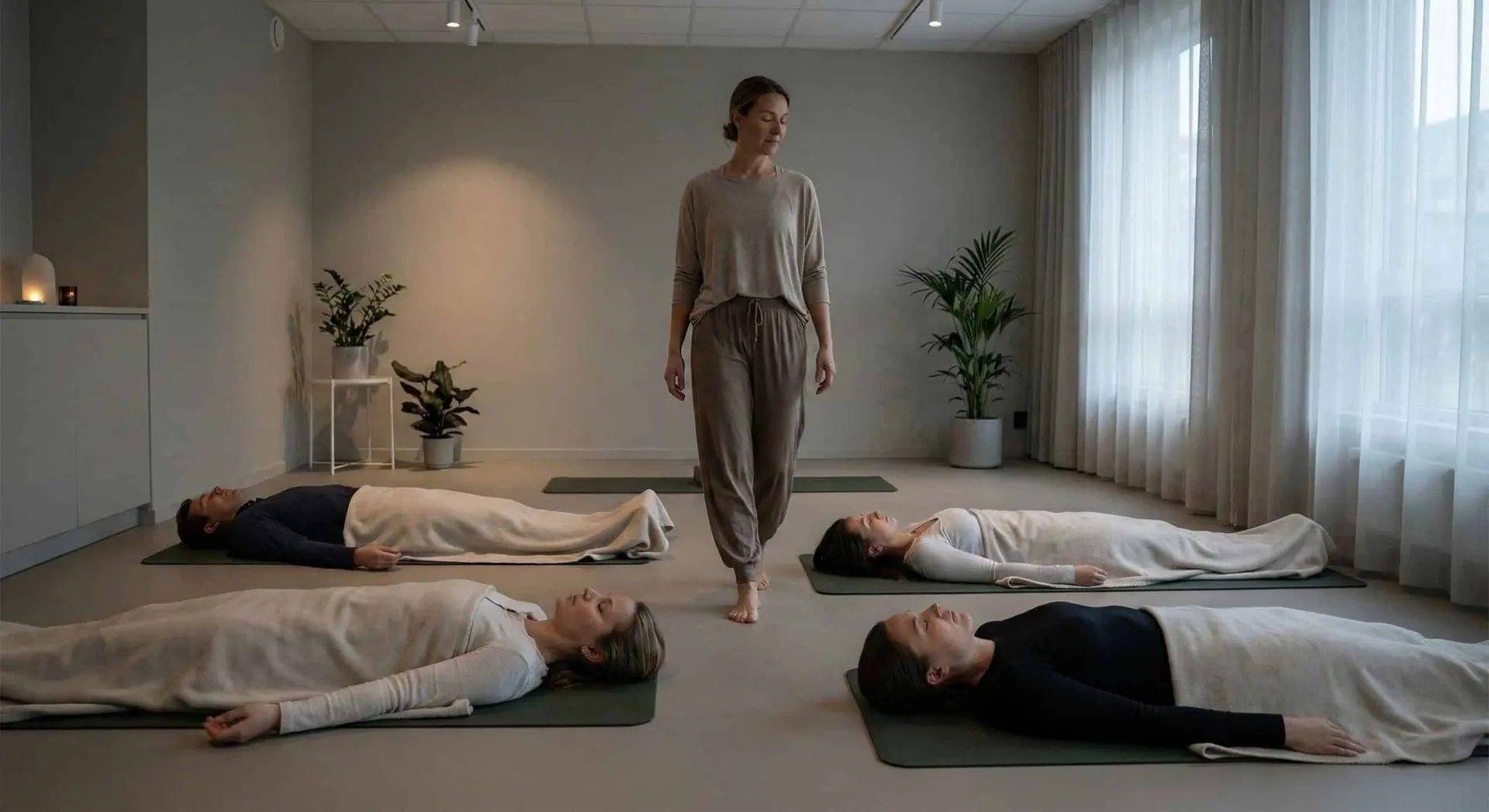
Mirosuna’s corporate sound meditation programme is delivered in-studio in South Melbourne or onsite at your premises. It requires no prior experience, no disclosure, no language about mental health (unless participants choose it). It is a session. It is recovery. It works.
For men who have never and would never book a therapy appointment, a group sound session with their team is often the first time they have experienced intentional nervous system regulation. That first experience changes what feels possible.
What Melbourne Teams Can Do This Week: Five Practical Actions
International Men’s Health Week runs June 8 to 14. Here are five actions a P&C Director or team lead can take this week with no budget approval required and no lengthy planning cycle.
- Host a group sound meditation session. Book Mirosuna onsite or at the South Melbourne studio. A 60-minute session for a team of 10 to 20 requires no explanation, no vulnerability framing. It’s a team activity. Book it at Sound Meditation.
- Share Men’s Health Australia resources directly. Men’s Health Australia (menshealthweek.org.au) produces event-ready materials for workplaces. Drop them in your team Slack or Teams channel with a note from a senior leader, not a system-generated broadcast.
- Reframe the check-in. This week, replace the standard ‘how’s everyone going’ with a structured 2-minute check-in at the start of team meetings: one word for how you’re feeling, one word for what you need. Low disclosure, high signal. Male employees participate when the format is brief, structured, and led by example.
- Make male leadership visible. Book visible senior male leaders into the wellness activation. When a CFO or GM attends a team sound session or shares a resource, it shifts the cultural signal more than any policy document.
- Follow with a structured programme. One week of activation followed by 51 weeks of unchanged conditions signals to employees that the effort was performative. Use International Men’s Health Week as the launch point for an ongoing somatic regulation programme, not the full stop.
How Mirosuna’s Corporate Programme Supports Men’s Health Year-Round
Mirosuna’s corporate wellness programme is designed as infrastructure, not an event. Multi-session sound meditation and somatic regulation engagements deliver the consistent parasympathetic activation that builds physiological resilience over time, the kind that shows up in reduced sick leave, lower EAP utilisation, and improved cognitive performance metrics at 90 days and beyond.
For Melbourne employers building a WHS-compliant psychosocial risk control framework, Mirosuna provides programme delivery documentation structured as auditable evidence of active hazard management. International Men’s Health Week is the right moment to start that conversation.