

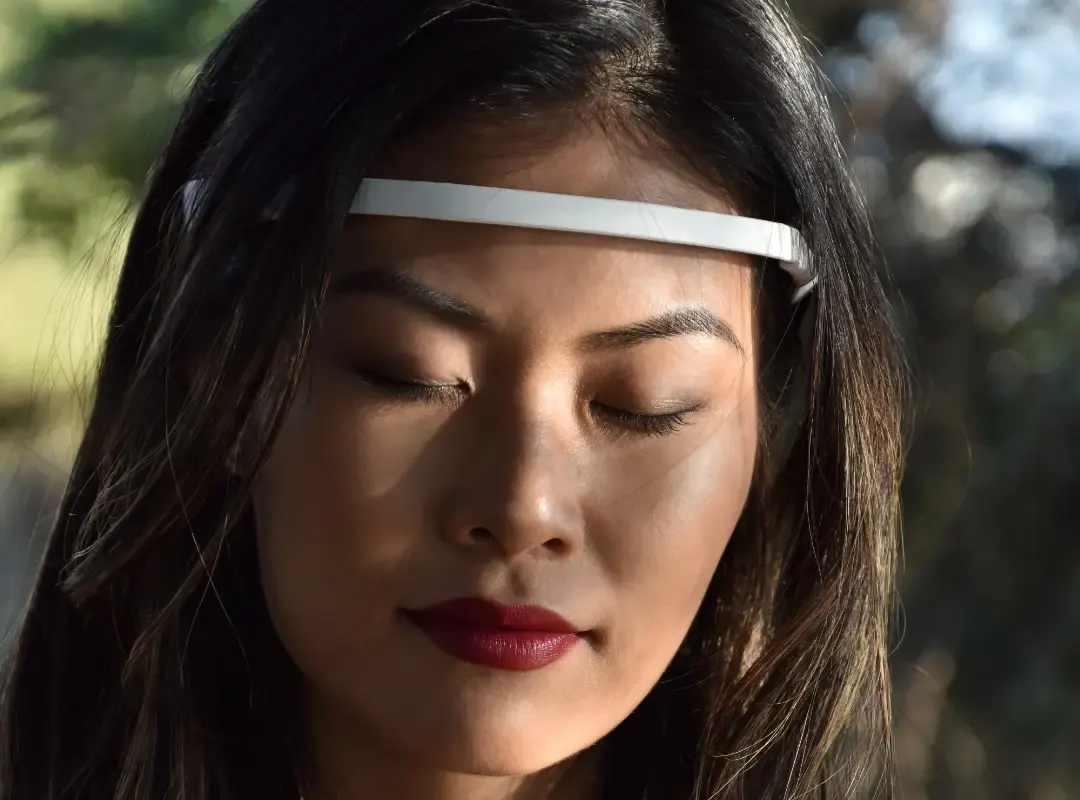
The Muse meditation device is a brain-sensing headband that plays you the sound of weather while you meditate, calming the soundscape as your mind settles and stirring it up when your thoughts wander. It is clever, it is genuinely fun, and for some people it is the thing that finally gets them sitting down every day. It is also not meditation itself, and I think it is worth being clear about both sides before you spend the money. Here is how it works, who it suits, and where I would be careful.
What the Muse actually is
Muse is a slim headband with EEG sensors that rest on your forehead and behind your ears. It pairs with the Muse app on your phone, reads the electrical activity of your brain, and translates it into audio feedback in real time. The algorithm behind it is built on years of EEG research into what a settling mind looks like electrically. Newer versions also track heart rate, breath and body stillness.
How a session works
You need three things: the headband, a smartphone and the app. Find a quiet spot, put the band on, choose how long you want to sit and pick a soundscape. The beach is my favourite.
Press start and you hear waves. The more active your mind, the louder they crash. As you settle, the water calms. At your calmest, you hear birds, and each bird is a point. Yes, it turns meditation into a bit of a game, and yes, it gets competitive when you and your partner or friends are doing it side by side. At the end you get a report showing your calm, neutral and active time across the session.
What I like about it
It answers the beginner's biggest question
Almost every new meditator asks me the same thing: am I doing this right? The Muse gives an immediate, tangible answer. When the waves quieten, you know you have found the state you are looking for, and you start to recognise what it feels like from the inside. One of our community, Shilpika, put it well: because of the audio feedback, you do not need someone standing there telling you whether your technique is right.
It builds the habit
Points, streaks and challenges are not deep, but they work. Several people have told me the device made them want to sit, rather than feel they should. Rob told me that after a couple of weeks he actively looked for time to use it. For anyone who has found meditation boring, that shift is worth a lot.
It makes progress visible
More experienced meditators can use the tracking to notice patterns: which time of day they settle fastest, how sleep or coffee change things, whether a new technique is helping. Paul, one of our regulars, said it helped him find a rhythm that quickly relaxed his mind and body, and that he felt he had the hang of it by his second attempt.
Where I would be careful
Chasing birds is not the same as letting go
This is my main reservation. Meditation is about allowing whatever arises, including restlessness, without grasping at a particular state. A points system quietly teaches you to strive for calm, and to feel you have failed when the waves get loud. If you notice yourself tensing up to earn birds, take the band off for a while. The device is training wheels, and training wheels come off.
The feedback is a proxy, not the truth
EEG through a consumer headband is an approximation. A noisy session can still be a valuable one, and a very quiet reading can simply mean you were drowsy. Treat the report as interesting information, not a verdict on your practice.
It adds a screen to a screen-free practice
Part of the value of meditation is time away from devices. Pairing, charging, updating and checking a report all pull you back towards the phone. For some people that is a fair trade; for others it defeats the purpose.
The research is promising but early
Small studies, including one from an Italian university, have compared daily Muse use against simple relaxation and found improvements in reaction time, resting brain states and self-reported stress over a few weeks. That is encouraging, but the studies are small and partly industry-linked, so I would hold the claims lightly. Research on meditation itself, with or without gadgets, is far more established.
Who it suits
The Muse is a good fit if you are a beginner who keeps drifting off and giving up, if you are motivated by data and games, or if you are an experienced meditator curious about tracking. It is a poor fit if you already have a settled practice, if you are prone to perfectionism, or if you meditate specifically to get away from technology. It is also not cheap, so I would suggest borrowing one or trying a friend's before you commit.
How to use it well
- Learn the basics first so the feedback has something to attach to. Our 7 Days of Meditation course teaches posture, breath and attention in a way the app cannot.
- Use it three or four times a week, not every session, and keep some sits completely unmeasured.
- Ignore the score during the session. Look at it afterwards if you are curious, then let it go.
- Plan to graduate. When you can find the calm without the birds, you have got what the device is for.
The verdict
Muse is a useful, enjoyable tool that can help a beginner learn what a settled mind feels like and build a daily habit. It is not a substitute for a teacher, a community or the simple discipline of sitting with yourself. If you want to explore the human side, join us for a guided session on our class timetable, or try a sound meditation where crystal and Tibetan singing bowls do the guiding without a single sensor. And if you are still working out which style suits you, our guide to types of meditation for beginners is a good place to start.