

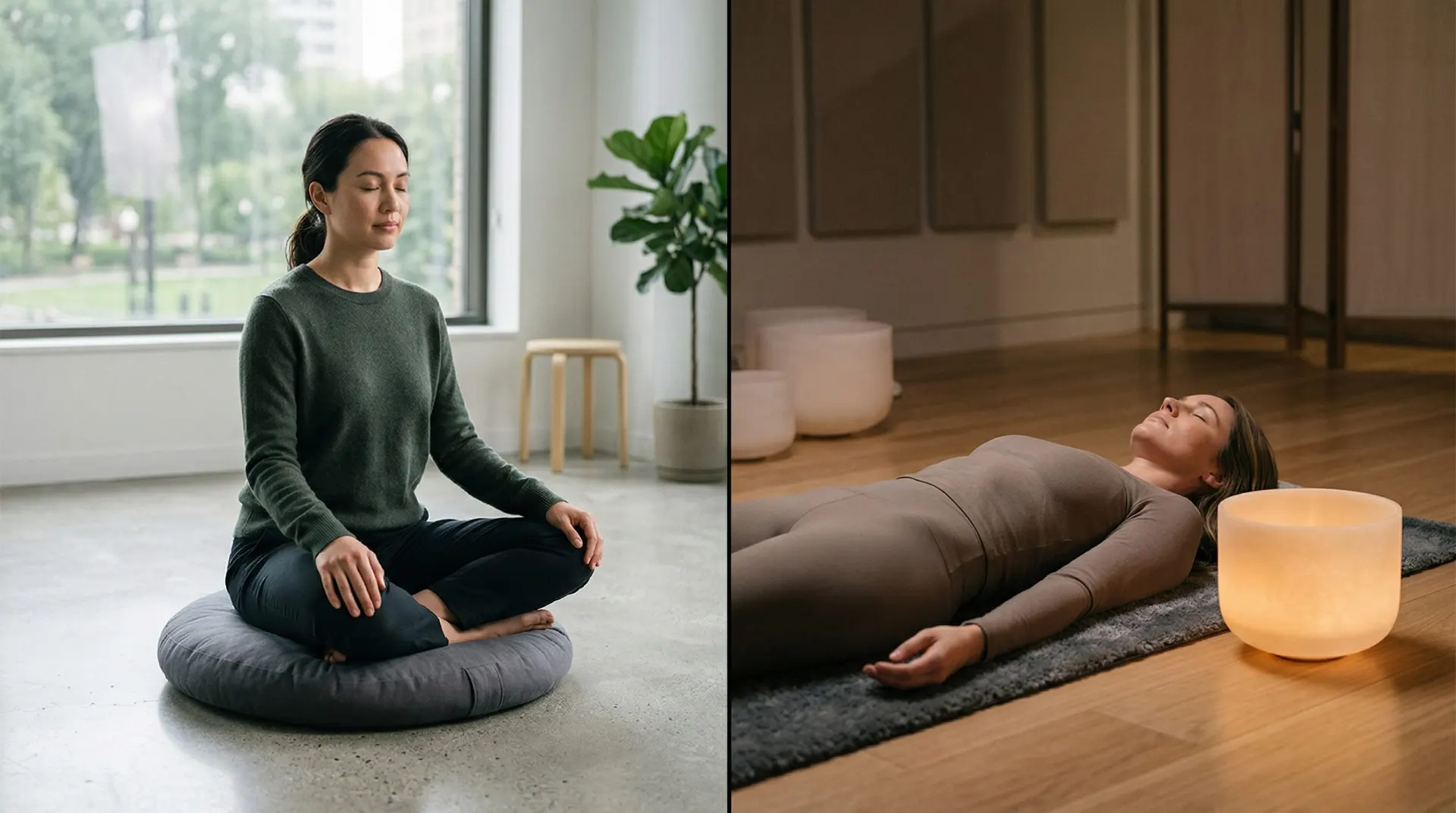
Choosing the right meditation style for your team can mean the difference between widespread adoption and empty chairs. While traditional seated meditation requires immense mental discipline, sound meditation offers an immediate, sensory-driven reset that bypasses the busy corporate mind.
Understanding Different Meditation Approaches
At its core, meditation is a practice of training the mind to achieve a state of deep relaxation and heightened awareness. The goal is to quiet the mental chatter that often contributes to stress and anxiety, allowing for greater clarity and inner peace. While there are countless techniques, they generally fall into two categories: focused attention, where you concentrate on a single object like the breath or a mantra; and open monitoring, where you observe your thoughts and feelings without judgment.
Traditional forms like Vipassanā and Zazen have been practised for thousands of years, rooted in ancient spiritual traditions. More contemporary approaches, such as Mindfulness-Based Stress Reduction (MBSR), have adapted these techniques for a secular, evidence-based context. Sound meditation, while also ancient in its use of instruments for healing, offers a distinctly different, more sensory-driven path to the same destination.
Traditional Meditation: Strengths and Challenges
Traditional meditation, particularly mindfulness, is what most people picture when they think of meditation. It typically involves sitting in a quiet space, closing your eyes, and focusing on the natural rhythm of your breath. The practice encourages you to observe your thoughts as they arise and pass without getting entangled in them.
Strengths:
- Builds Discipline: It is a powerful discipline that cultivates self-awareness and emotional regulation over time.
- Accessibility: It requires no special equipment and can be practised anywhere, anytime.
- Strong Evidence Base: A vast body of scientific research supports its benefits for mental and physical health, including reduced stress, improved concentration, and lower blood pressure.
Challenges:
- Steep Learning Curve: For many beginners, the instruction to simply “watch your thoughts” can be frustrating. The mind naturally wanders, and it can feel like a constant battle to remain focused, leading many to believe they are “failing” at meditation.
- Requires Active Effort: It is an active and disciplined practice. This can be a significant barrier for employees who are already feeling mentally fatigued or overwhelmed.
- The “Inner Critic”: For those new to the practice, sitting in silence can sometimes amplify anxious thoughts or self-criticism, making the experience more stressful rather than less.
Sound Meditation: A Different Entry Point
Sound meditation, often referred to as a “sound bath” or “sound healing,” uses therapeutic instruments like Himalayan singing bowls, crystal bowls, gongs, and chimes to create a landscape of immersive sound and vibration. Participants simply lie down comfortably and let the resonant frequencies wash over them. Instead of actively trying to quiet the mind, the sound does the work for you.
This approach is based on the principle of sympathetic resonance. The complex, overtone-rich sounds help to shift brainwaves from the active Beta state (normal waking consciousness) to the more relaxed Alpha and Theta states, where deep meditation and healing can occur. It’s a passive experience; the only requirement is to listen. This makes it one of the most approachable types of meditation for newcomers.
Accessibility: Why Sound Works for Beginners
When considering meditation for beginners, accessibility is paramount. Traditional meditation asks you to *do* something: to focus, to observe, to be disciplined. In contrast, sound meditation invites you to simply *be*. There is nothing to get right or wrong. This removes the pressure and performance anxiety that can derail early attempts at mindfulness.
For a corporate team with diverse levels of experience and openness to contemplative practices, sound meditation provides a level playing field. It requires no prior knowledge or skill, making it an inclusive activity that everyone can benefit from immediately. The sensory nature of the experience gives the busy mind something tangible to focus on, making it far easier to disengage from the endless loop of work-related thoughts and to-do lists. Mirosuna’s corporate wellness programs often leverage sound meditation as a foundational experience for this very reason.
The Sceptic Factor: Which Works for Non-Believers?
In any workplace, you will find a spectrum of personalities, from the wellness enthusiast to the hardened sceptic. The latter group can be particularly challenging to engage. To a sceptic, the abstract nature of traditional meditation can feel vague or “woo-woo.” They may question the point of sitting in silence or struggle to see the tangible benefit.
This is where the sound meditation vs meditation debate becomes crucial. Sound meditation is a physical, sensory experience. You don’t just hear the sounds; you feel the vibrations resonating through your body. This tangible aspect makes it more concrete and less esoteric. It feels less like a spiritual practice and more like a deep relaxation session, making it a much easier “sell” to those who are wary of traditional meditative disciplines. Many sceptics walk away from a sound bath surprised by the profound sense of calm and clarity they experience.
Group Dynamics: Shared vs Individual Experience
While traditional meditation is often a solitary journey inward, a group sound bath creates a powerful collective experience. Sharing a space where everyone is immersed in the same resonant frequencies fosters a unique sense of connection and shared vulnerability. This can be incredibly beneficial for team cohesion, breaking down hierarchical barriers and encouraging a more supportive workplace culture.
For organisations looking for the best meditation for workplace cohesion, the shared journey of a sound bath can be more impactful than individual practices. It creates a memorable, positive event that becomes a common reference point for the team, reinforcing the company’s commitment to their collective wellbeing. It’s an experience that is both deeply personal and unifying at the same time.
Outcomes Comparison: What Research Shows
Both traditional and sound meditation have been shown to be effective at reducing stress, anxiety, and depression while improving mood and focus. Research from institutions like the Benson-Henry Institute for Mind Body Medicine at Harvard has extensively documented the physiological benefits of the “relaxation response” elicited by traditional meditation.
Similarly, emerging research into sound meditation highlights its ability to quickly induce meditative states and reduce tension, anger, and fatigue. A 2018 study published in the *Journal of Evidence-Based Integrative Medicine* found that participants in a sound bath reported significantly less tension, anger, fatigue, and depressed mood. The key difference often lies in the speed and ease of achieving these outcomes. For many, sound meditation offers a more direct and effortless route to a state of deep relaxation.
Making the Choice for Your Workplace
So, when it comes to sound meditation vs traditional meditation, which is right for your team? The answer depends on your goals and your people.
Traditional meditation may be a good fit if:
- Your team is already interested in mindfulness and has some experience.
- You are looking to build long-term skills of mental discipline and self-awareness.
- You want to empower employees with a tool they can use independently.
Sound meditation is likely the better choice if:
- Your team is new to meditation or includes many sceptics.
- Your primary goal is immediate stress reduction and relaxation.
- You want to create a powerful, unifying team-building experience.
For most organisations, sound meditation serves as a more effective and inclusive entry point. It bypasses the common hurdles of traditional practice, offering a direct and enjoyable experience of deep calm that can win over even the most stressed-out and sceptical employees. By providing an accessible first step, you can open the door to a wider culture of wellness and perhaps even inspire individuals to explore other types of meditation on their own.
At Mirosuna, we specialise in creating transformative experiences that introduce teams to the profound benefits of mindfulness through sound. Our corporate wellness programs are designed to be accessible, engaging, and effective for everyone, regardless of their prior experience.
Ready to transform your workplace with evidence-based wellness programs? Contact Mirosuna today to discuss how we can support your team’s wellbeing.