

Updated November 2026.
Sound meditation is the practice we recommend first to people who tell us they cannot meditate. You lie down, get comfortable, and the sound does the work. There is no technique to learn and nothing to concentrate on. This guide covers what sound meditation is, why it suits a stressed nervous system, what the research says, and what your first session will feel like.
Quick answer: sound meditation is a lying-down meditation where instruments such as singing bowls are played live to guide you into deep rest. The main benefits are less tension and stress, a calmer mood, better sleep and an easy way into meditation. In a 2017 study of 62 adults, a singing bowl meditation was followed by significantly less tension, anger, fatigue and depressed mood. At Mirosuna in South Melbourne a session is 1.5 hours and costs $80.
Sound meditation benefits at a glance
| Benefit | What people notice | What the evidence says |
|---|---|---|
| Less tension and stress | Jaw, shoulders and breath soften | Significant drop in tension after singing bowl meditation (2017 study) |
| Calmer mood | Less irritable, lighter | Less anger, fatigue and depressed mood (2017 study) |
| Better sleep | "Best sleep in months" the night after | Reported by participants; sleep trials are still limited |
| A quieter mind | Thoughts lose their grip | Consistent with research on sound and stress response (2025 review) |
| Easy entry to meditation | No technique needed | Biggest tension drop in first-timers (2017 study) |
| Emotional release | Feelings surface and pass | Common in practice; not well studied |
What is sound meditation?
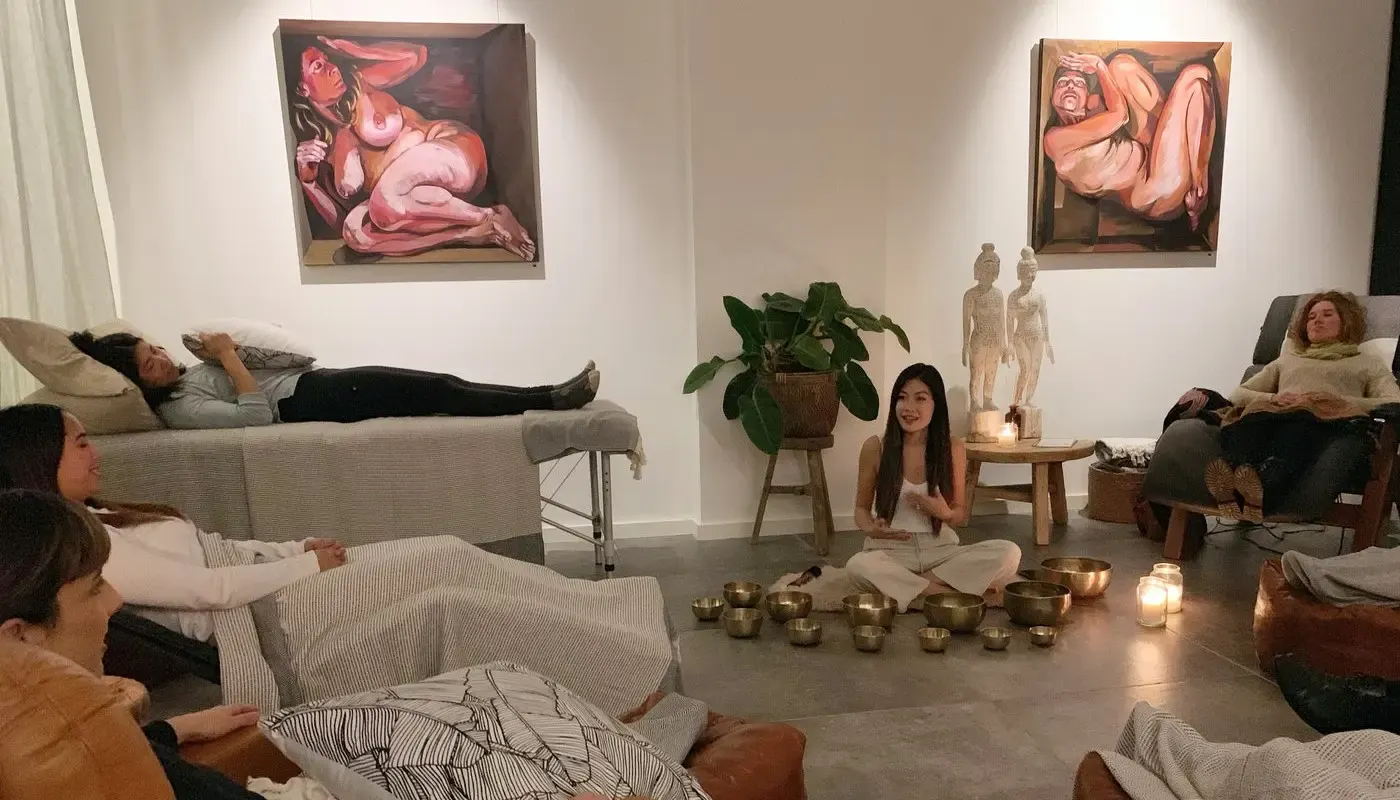
Sometimes called a sound bath or sound healing, sound meditation is a guided, lying-down meditation in which instruments are played live to carry you into a meditative state. At Mirosuna we play alchemy crystal singing bowls, whose sustained, layered tones fill the room. A session opens with a short settling of the breath and body, moves into an extended period of sound, and ends with silence and a gentle return.
The practice is old. Singing bowls have been used in Himalayan traditions for centuries, and sound has been part of healing rituals in almost every culture. What is new is that researchers have started measuring what it does.
How does sound bath meditation affect the body and mind?
The nervous system stands down
Stress lives in the sympathetic nervous system: raised heart rate, shallow breath, cortisol. Lying still while slow, resonant sound fills the room helps switch on the parasympathetic "rest and digest" branch. Breathing deepens and muscles release. A 2025 scoping review in JMIR Mental Health of 34 studies of sound interventions and stress described sound as a "promising, noninvasive" way to reduce stress, while noting that results depend on the person and the setting and that more research is needed.
The mind gets something to rest on
The hardest part of silent meditation is that a busy mind has nothing to hold. Sustained tones give it something absorbing and effortless to follow. Many people feel the bowls in the chest, belly or hands as well as hearing them, which pulls attention out of thinking and into the body.
Mood lifts
In a 2017 observational study of 62 adults (mean age 49.7) published in the Journal of Evidence-Based Complementary and Alternative Medicine, participants reported significantly less tension, anger, fatigue and depressed mood after a singing bowl meditation, and a greater sense of spiritual wellbeing. People who had never tried it before had the biggest drop in tension. Because it was observational, it shows an association rather than proof of cause.
What are the benefits of sound meditation?
- Stress and anxiety relief. The most consistent effect, and the reason most people come. Clients often tell us the calm lasts for days.
- Better sleep. "Best sleep in months" is the message we receive most often the morning after. If sleep is your problem, start here and read our guide to improving sleep quality.
- A quieter mind. Thoughts do not stop, but they lose their grip.
- Physical release. Jaw, shoulders and hips soften as the body rests.
- Emotional processing. It is common to feel emotion surface during a session and pass.
- An entry point to meditation. Once you know what a deeply relaxed state feels like, it is far easier to find on your own. Many of our regulars go on to Mirosuna's mindfulness classes and 7 Days of Meditation.
What happens at a sound meditation session?
Wear something comfortable and warm; body temperature drops as you relax. You lie on a mat with a bolster, blanket and eye pillow, or on one of the couches. The facilitator guides you through a short settling of the breath, then the bowls begin. Some people drift to sleep, some stay aware throughout, and both are fine. Afterwards there is time to sit up slowly, drink some water and let the calm settle. Plan a quiet evening rather than a big one.
Sound meditation is gentle and suits almost everyone. If you are pregnant, please check with your doctor or midwife first. If you have a pacemaker, epilepsy or a sound-sensitive condition, please let us know when you book so we can position you and choose instruments accordingly.
Where can you try sound meditation in South Melbourne?
Sound meditation at Mirosuna, South Melbourne runs through the week: a 1.5 hour session with alchemy crystal singing bowls for $80, in Classic, Full Moon and New Moon variations. Sessions are booked through the Mirosuna app; see the class timetable for this week.
Prefer something private? A private sound meditation is 1 hour for up to two people ($250), and couples sound meditation is 1.5 hours for $390. We also bring sound to workplaces through Mirosuna corporate wellness.
Mirosuna is at 18A Ross Street, South Melbourne. To book, please use the Mirosuna app or email hello@mirosuna.com. Thank you.
Curious about the instruments? Read what Alchemy Crystal Singing Bowls are, our beginner’s guide to sound meditation or the science behind sound healing.
Frequently asked questions
What is sound meditation?
Sound meditation is a guided meditation where you lie down while instruments such as singing bowls are played live. The sound gives your mind something effortless to follow, so you can rest deeply without needing a meditation technique.
Is a sound bath the same as sound meditation?
Yes, the terms are used for the same practice. "Sound bath" describes the feeling of being immersed in sound; "sound meditation" describes the purpose.
How long do the effects of sound meditation last?
Most people feel calm immediately afterwards, and many tell us it lasts for days. Regular sessions make the relaxed state easier to return to on your own.
Do I need meditation experience?
No. Sound meditation suits beginners best: in the 2017 singing bowl study, first-timers had the biggest drop in tension. You simply lie down and listen.
How much does sound meditation cost at Mirosuna?
A 1.5 hour group sound meditation at Mirosuna in South Melbourne is $80, booked in the Mirosuna app. A private sound meditation for up to two people is $250 for 1 hour.
What should I bring?
Just yourself in warm, comfortable clothes. Mats, bolsters, blankets and eye pillows are provided.